Custodial vs Non-Custodial Crypto Cards: What’s the Difference and Why Does It Matter?
Your Crypto. Your Wallet. Your Control.
Cryptocurrency has transformed how people store, transfer, and manage digital assets. Yet when it comes to spending crypto in everyday life, many crypto cards still rely on a traditional model: users must first transfer funds to a card provider before making purchases.
This creates an important question: Why should you give up control of your crypto just to spend it?
Self-custodial crypto card technology offers a different approach.
In this guide, we’ll explain the differences between custodial and non-custodial crypto wallets, how crypto card payment systems work, the advantages and limitations of each model, and how Xerovan aims to simplify crypto spending through self-custodial wallet integration.
What Is a Custodial Crypto Wallet?
A custodial wallet is a cryptocurrency wallet in which a third-party service provider controls the private keys or otherwise holds custody of the user’s digital assets.
Common examples include wallets and balances operated by centralized cryptocurrency exchanges and financial service platforms.
With custodial wallets, users typically access their funds through an account provided by the platform rather than independently controlling the private keys.
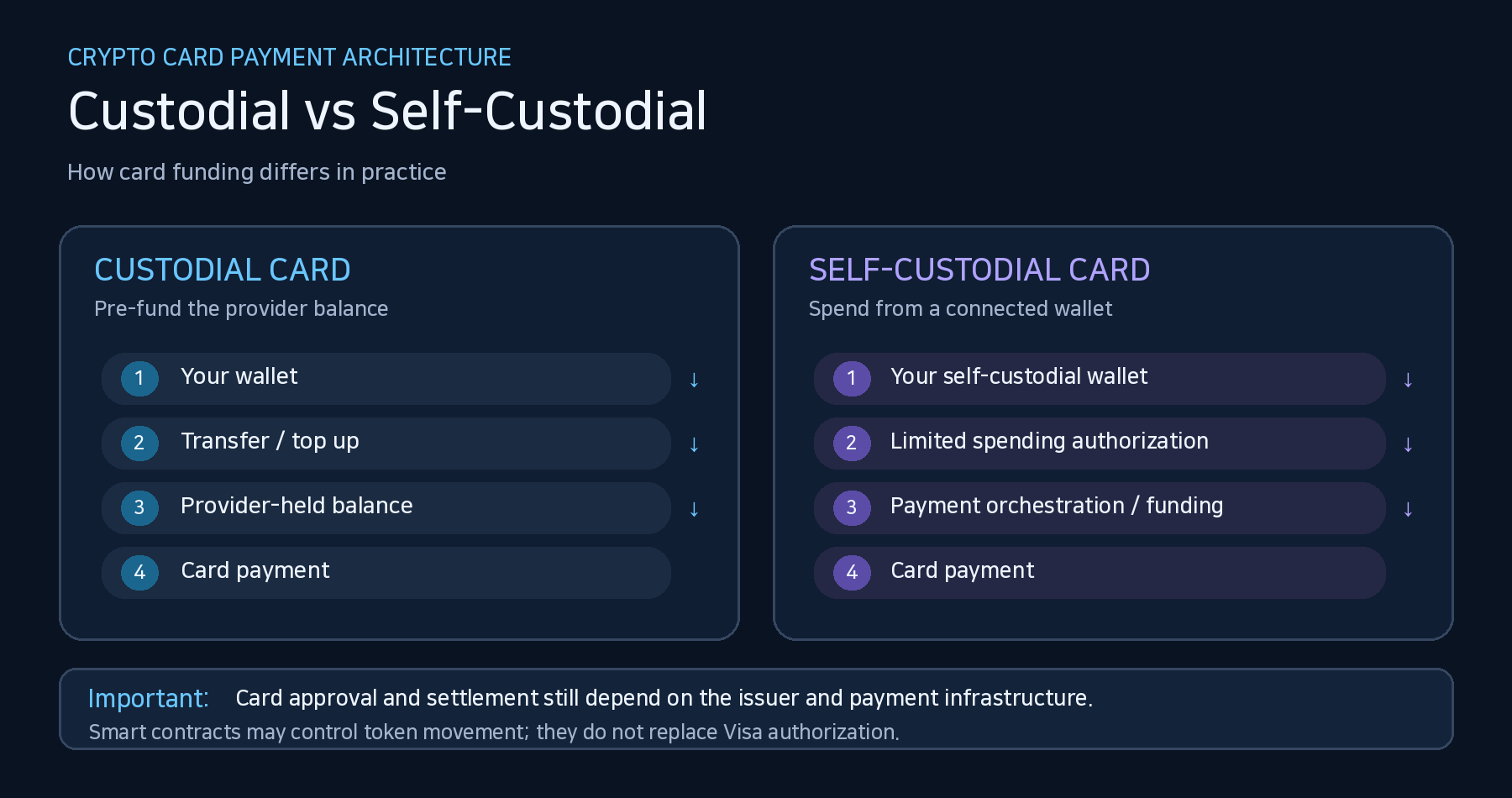
How custodial crypto card payments typically work:
- The user deposits cryptocurrency into an account controlled by the service provider.
- The user transfers crypto to a card balance or designated funding account, if required.
- The service provider maintains the available card balance.
- When the user makes a purchase, the card transaction is authorized against that balance.
- The service provider handles the relevant conversion, funding, and settlement processes.
This model can be convenient, especially for users already familiar with traditional banking and prepaid cards.
However, it also introduces a significant consideration: users depend on the service provider to safeguard their deposited funds and provide continued access to them.
Not all custodial crypto cards require manual top-ups. Some support automatic conversion or linked exchange balances, but the underlying custody relationship remains important.
What Is a Non-Custodial (Self-Custodial) Crypto Wallet?
A non-custodial wallet, also known as a self-custodial wallet, allows users to control their cryptocurrency through their own cryptographic signing authority.
Rather than relying on a centralized provider to hold assets on their behalf, users retain control of the wallet’s authorization mechanism.
Examples of self-custodial wallet technologies include software wallets, hardware wallets, and certain Multi-Party Computation (MPC) wallet architectures.
The fundamental principle is straightforward:
Users control their crypto assets instead of transferring custody to a platform simply to store them.
For self-custodial crypto cards, this creates the opportunity to connect crypto spending directly to the user’s wallet.
How Xerovan’s Self-Custodial Crypto Card Works
Xerovan is designed around a different approach to crypto card funding.
Instead of requiring users to manually transfer cryptocurrency into a separate card balance before spending, Xerovan’s proposed payment architecture connects the card to an authorized self-custodial wallet.
The goal is to make crypto spending feel more natural, while allowing users to retain wallet-level control over their digital assets before transactions occur.
Step 1: Create or Connect Your Wallet
Users can create a self-custodial wallet through Xerovan’s integrated wallet infrastructure.
The platform is designed to support wallet technology powered by Fireblocks, a recognized provider of digital asset security and wallet infrastructure.
Xerovan also plans to support compatible external wallets, including wallets such as MetaMask, subject to network and authorization compatibility.
This gives users more flexibility when choosing where to hold their cryptocurrency.
Step 2: Authorize Card Spending
Before enabling spending, users grant the permissions required by the supported payment architecture.
Depending on the blockchain and token, this can involve smart contract allowances, signed authorizations, or other controlled transaction mechanisms.
A properly designed authorization system can define restrictions such as approved tokens, spending limits, designated contract addresses, or revocation conditions.
These controls must be implemented and verified by the payment system; they are not automatic features of every self-custodial wallet.
Step 3: Make a Card Payment
When the user makes an eligible purchase, the connected payment infrastructure can initiate the required funding process using previously authorized wallet permissions.
The user does not need to manually transfer funds into a separate prepaid card balance before each purchase.
The payment system must still confirm sufficient eligible funds, apply applicable exchange rates and fees, and meet the requirements of the card issuer.
Step 4: Complete Funding and Settlement
The approved payment instruction triggers the necessary crypto funding or asset conversion flow.
The actual card authorization and merchant settlement are processed through the issuer, card network, and relevant payment partners.
Blockchain transfers and traditional card settlement are separate processes, even when they operate together to create a seamless user experience.
The result is a more connected crypto spending experience, with fewer manual funding steps and greater user control over assets before spending.
Custodial vs Non-Custodial Crypto Cards: Key Differences
| Feature | Custodial Crypto Card | Xerovan Self-Custodial Model |
|---|---|---|
| Wallet control | Provider controls custody | User retains wallet authorization control |
| Card funding | Often requires a provider balance | Designed for connected-wallet funding |
| Manual top-up | Frequently required | Designed to eliminate routine manual top-ups |
| Private key management | Managed by provider | User-controlled or user-authorized signing architecture |
| Smart contracts | Not necessarily required | May support controlled spending permissions |
| External wallet integration | Depends on provider | Planned support for compatible wallets |
| Provider dependency | Custody, account and card services | Card issuance, conversion and settlement still depend on partners |
| Primary risk | Custodial and platform exposure | Wallet security, permissions and integration exposure |
The most important distinction is not simply where the cryptocurrency is stored.
It is who controls the digital assets before they are spent, and how spending authorization is managed.
Why Smart Contracts Matter for Self-Custodial Crypto Card Security
Smart contracts are programs deployed on a blockchain that execute defined operations when their conditions are satisfied.
In a self-custodial crypto payment architecture, smart contracts can help control how an authorized amount of cryptocurrency is transferred.
For example, a contract may be designed to permit only specific tokens, approved contracts, or authorized transaction conditions.
Transparent On-Chain Rules
When a smart contract is deployed on a public blockchain, its transactions and relevant on-chain state may be independently inspected.
This introduces transparency that is different from purely internal accounting records maintained by a centralized service provider.
Controlled Authorization
Users can potentially authorize spending without transferring all their crypto assets into a service provider’s custodial wallet.
A well-designed permission system can reduce unnecessary exposure by granting only the access required for the intended payment function.
Immutable Records — With Important Qualifications
Blockchain transaction history is generally resistant to unilateral modification.
However, not every smart contract is immutable. Some contracts use upgradeable proxies, administrative permissions, or configurable settings.
Consequently, security depends on the exact contract architecture, privilege model, allowance limits, code quality, and operational safeguards.
Smart contracts can make payment permissions more transparent and enforceable, but they do not eliminate all security risks.
For cardholders, this means reviewing spending permissions and understanding which functions can be changed, paused, or revoked.
The Role of Fireblocks in Xerovan’s Wallet Infrastructure
Wallet security is a foundational requirement of any self-custodial crypto payment experience.
Xerovan is designed to integrate Fireblocks wallet infrastructure to support secure digital asset management.
Fireblocks is widely known for its digital asset security technologies, including MPC-based cryptographic infrastructure.
MPC technology can distribute cryptographic signing operations across multiple participants or components, reducing reliance on a single exposed private key.
However, MPC and self-custody are not the same thing. Whether users independently control their funds depends on the signing policy, key-share arrangement, recovery procedures, and the permissions retained by the infrastructure provider.
Xerovan’s goal is to combine user-controlled wallet authorization with convenient card payments.
Where supported, users will be able to access the Xerovan wallet experience without a separate wallet creation fee.
This does not necessarily mean blockchain network fees, currency conversion fees, or card transaction fees are waived.
Can You Connect MetaMask or Another External Wallet?
One of the planned advantages of Xerovan’s wallet architecture is flexibility.
Instead of requiring every user to move cryptocurrency into a newly created wallet, Xerovan intends to support compatible external wallets.
For example, a user who already manages assets through MetaMask may be able to connect that wallet and authorize it as a payment funding source.
The wallet must support the relevant network, digital asset, transaction signatures, and payment authorization method.
Importantly, connecting a wallet is not the same as granting unrestricted spending access.
Users should review contract permissions, spending allowances, and security warnings before authorizing transactions.
Advantages of Self-Custodial Crypto Cards
1. Greater Control Over Digital Assets
Users can retain direct control of their wallet and signing authorization instead of depositing all their assets into a centralized card funding account.
2. No Routine Manual Preloading
A connected-wallet architecture can eliminate the repeated process of transferring cryptocurrency to a card balance before purchases.
3. Reduced Custodial Exposure
Keeping crypto outside a provider-controlled funding balance can reduce exposure to certain custody risks, although card providers, payment partners, and smart contracts still introduce dependencies.
4. More Flexible Wallet Management
Compatible wallet integration may allow users to manage assets in an existing wallet rather than maintaining separate balances across multiple platforms.
5. Transparent Blockchain Activity
On-chain transfers and contract interactions can be independently inspected through blockchain explorers, giving users additional visibility into blockchain-side payment activity.
What Are the Limitations of Self-Custodial Crypto Cards?
Self-custodial payment systems also introduce responsibilities and trade-offs.
Wallet security remains the user’s responsibility. A compromised device, malicious signature, or incorrectly configured permission can still result in financial loss.
Gas fees and liquidity requirements may apply. Even when manual top-ups are eliminated, moving or converting crypto can involve blockchain fees, liquidity costs, and processing delays.
A card transaction is not identical to a blockchain transaction. Card authorizations, merchant refunds, reversals, and settlement can involve processes that differ substantially from an irreversible on-chain transfer.
Supported assets and networks may be limited. Not every token or blockchain can necessarily fund card purchases directly.
External payment dependencies remain. A self-custodial architecture does not remove the need for regulated card issuance, compliance, transaction processing, and fiat settlement.
The best crypto card experience must balance asset control with reliable payment execution.
Is a Self-Custodial Crypto Card More Secure?
The answer depends on the specific architecture.
Self-custody can reduce the risk associated with storing funds on a centralized platform. However, users become responsible for signing security, wallet permissions, recovery processes, and safeguarding connected devices.
Custodial services may offer simpler recovery and customer support, while introducing counterparty and custody risks.
Neither model is universally safer in every situation.
For Xerovan, the objective is to combine the benefits of self-custodial wallet control with carefully managed payment authorizations, reliable infrastructure, and an accessible user experience.
Frequently Asked Questions
What is the difference between custodial and non-custodial crypto cards?
Custodial crypto cards rely on a provider-controlled account or wallet to hold or manage crypto assets. Self-custodial crypto cards aim to enable spending from user-controlled wallets through authorized payment infrastructure.
Can I use a crypto card without transferring funds to a separate card wallet?
Some self-custodial card architectures are designed to support connected-wallet spending, reducing or eliminating manual preloading. Availability depends on the provider and its funding model.
Does a non-custodial crypto card still require KYC?
Yes, it may. Self-custody does not automatically exempt a card product from identity verification, anti-money-laundering requirements, sanctions screening, or other applicable regulations.
Can a smart contract withdraw all my crypto?
That depends on the authorization granted. An unlimited token allowance or overly broad signing permission can expose substantial funds. Carefully scoped permissions and revocation mechanisms are important safeguards.
Can I use MetaMask with Xerovan?
Xerovan plans to support compatible external wallets, including MetaMask-style wallet connections. Actual availability depends on supported networks, assets, wallet integration, and payment authorization capabilities.
Do I need to pay gas fees when spending crypto with a self-custodial card?
Blockchain transaction costs may apply. Whether users pay gas directly, receive sponsored transactions, or have fees included in a conversion rate depends on the payment provider’s implementation.
The Future of Crypto Spending Is Connected Wallets
Crypto cards should make digital assets easier to use in everyday life.
For many users, the experience can be improved by eliminating repetitive manual top-ups, reducing unnecessary custody transfers, and offering clearer visibility into wallet permissions.
Xerovan is building toward this vision through self-custodial wallet integration, configurable transaction authorization, and connected card funding.
Your crypto stays under your wallet’s control until authorized spending occurs — without the need to repeatedly preload a separate card balance.
Discover a more flexible approach to crypto spending with Xerovan.
Explore Xerovan at xerovan.com.
Disclaimer: Product capabilities, wallet integrations, funding methods, supported networks, fees, and availability are subject to implementation, issuer approval, jurisdiction, and applicable terms. Cryptocurrency and smart contract transactions involve financial and technical risks.